Per bar, per kilogram, per gram. Two tell the truth, one misleads
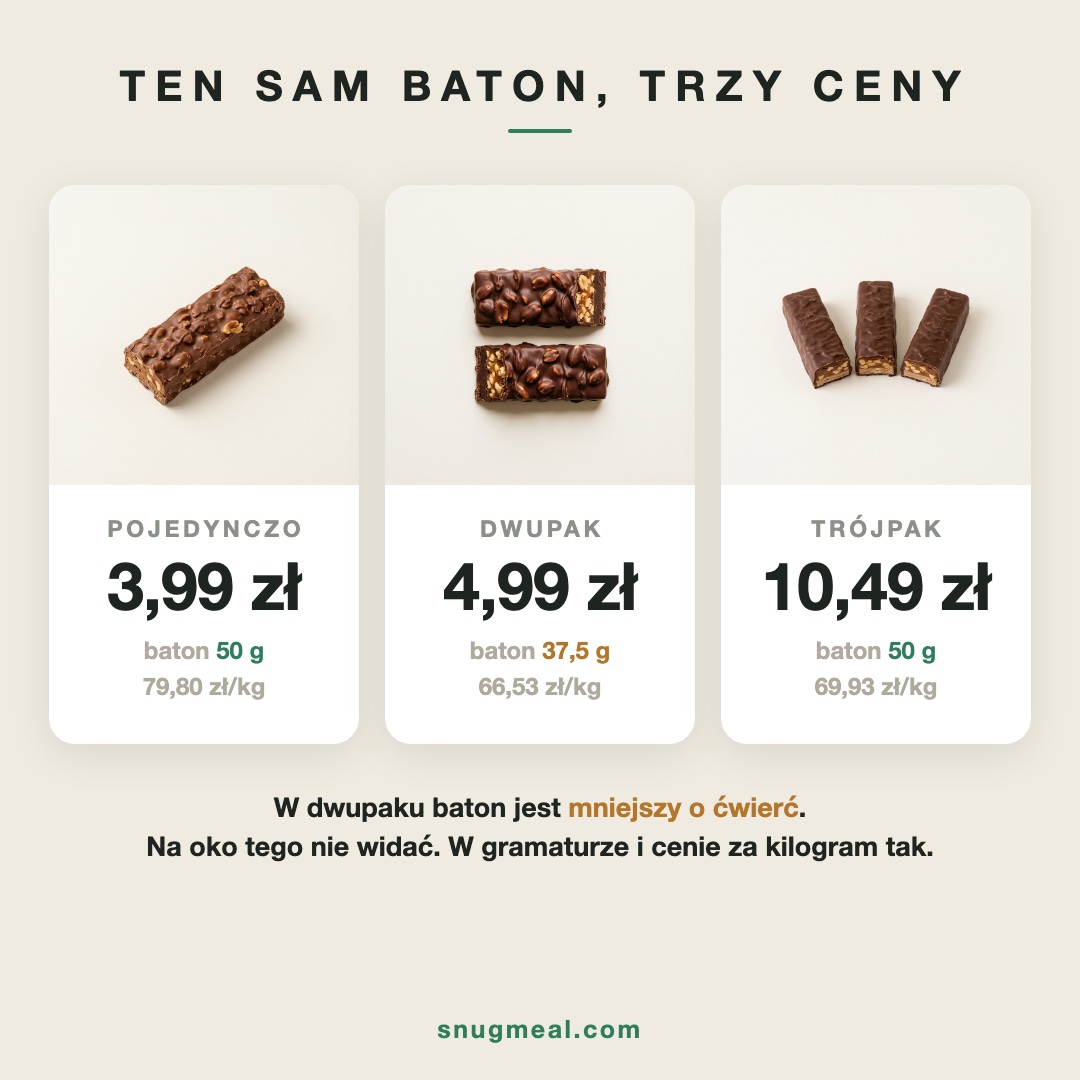
In a Snickers twin-pack the bar weighs 37.5 grams, not 50. It's a quarter smaller than the one you buy singly, though it looks like a deal on the shelf. The same bar has three prices at Biedronka, depending on the pack, and each tells a different story.
Three prices for the same bar
Prices and weights checked live in August 2026:
- Single bar 50 g: 3.99 zł, that's 79.80 zł per kilogram.
- Twin-pack, two bars of 37.5 g: 4.99 zł, that's 66.53 zł per kilogram and 2.50 zł a bar.
- Triple-pack, three bars of 50 g: 10.49 zł, that's 69.93 zł per kilogram and 3.50 zł a bar.
Look at how the three measures disagree. Per bar the twin-pack is cheapest, 2.50 zł, and that's the one that looks like a deal. Per kilogram the twin- and triple-packs are close, and the single bar is clearly the dearest. But the weight of one bar shows the trick: in the twin-pack the bar shrank to 37.5 grams. You pay less per bar because the bar is a quarter smaller. If you want a full bar cheaply, you take the triple-pack, where the bars are 50 grams.
Bigger doesn't mean cheaper
The flip side of the same mechanism is on the pasta shelf. Szlachecki 5-egg pasta in a 250 g pack costs 2.99 zł, that's 11.96 zł per kilogram. The bigger pack, Szlachecki 4-egg grated noodles 500 g, is 6.65 zł, that's 13.30 zł per kilogram. The smaller pack of richer pasta comes out cheaper per kilogram than the twice-as-big pack of noodles.
It isn't the same product, and honestly: the first has five eggs and is plain pasta, the second has four eggs and is grated noodles, a different form. It isn't that one is better. It's that the pack size alone tells you nothing about the price per kilogram. Sometimes the big one wins, sometimes the small one.
One honest metric
On the shelf there's one number that doesn't lie: the price per kilogram on the little tag under the product. In a multi-pack, add the weight of a single unit to it, because that decides whether "cheaper per unit" means "less food". A big pack and a multi-pack are packaging, not prices.
We showed this from the other side already, with spices and groats, where the big bag beat the small one. The rule works both ways, and that's exactly why you count it rather than guess. The format plays on the intuition that more units or a bigger pack means cheaper. Sometimes it does, sometimes not, and only the price per kilogram tells you which.
With the single bar one thing doesn't change: we counted before that sweets are among the priciest calories in the shop. Counted separately, 79.80 zł per kilogram is still a lot. This post isn't urging you to buy a Snickers, it shows the format mechanism that works on every shelf.
Why we count this
Snugmeal counts the price per kilogram and the weight for you, across a whole week of shopping, around your budget and prices from Polish stores, with the shopping total worked out up front.
Data: zakupy.biedronka.pl, prices and weights checked live in August 2026. Price per kilogram and per unit calculated from the package price and weight, pasta ingredients from the labels. Our own calculations.